
From Horse and Buggy to Airplane: Mennonites from Belize in Germany
- Andreas Tissen

- 20. Feb.
- 7 Min. Lesezeit






Five Mennonites from Belize are visiting friends in Germany. They were invited by Benjamin Hedert. Together they want to travel through Europe, to the places where the history of their ancestors began. I am able to join them for part of this journey.


Where It All Began
In their homeland, the horse and buggy are still important means of transportation. As Old Colony Mennonites, they live very traditionally, with simple clothing and limited use of technology. Now they are sitting on an airplane, flying across the Atlantic to a country they see as the starting point of their history: Germany.
Their family history is like a long migration. From Holland (today’s Netherlands) and Germany, their ancestors moved to West Prussia. From there they went to southern Russia, and later through Canada and Mexico until they finally reached Belize. They were always searching for land and a place where they could live their faith freely, without military service.


Büdingen: Meeting the Past
The first stop is Büdingen, near Frankfurt. During a city tour, they learn about old churches, parts of the city wall, and buildings that already stood 500 years ago, when the Reformation changed Europe.
At the same time, the Anabaptist movement began here. The Mennonites later grew out of this movement. For our guests, these places are more than beautiful old towns. Germany feels like a piece of spiritual home.


Ingolstadt: History You Can Touch
The next day, Benjamin takes them to Ingolstadt. He explains the most important places connected to the Anabaptists and Mennonites in Europe and talks about the life of Menno Simons.
During the city tour, he shows them the town square where the Anabaptist Michael Fischer once received his death sentence. The past suddenly feels very close.



Shopping with Restraint
Later they walk through the downtown area and look at the different stores. They buy a few things. When it comes to chocolate, however, they do not hold back.
In everyday life they are usually careful with spending, even though many of them have reached a modest level of prosperity. They work hard and mainly invest their money in their own businesses.


First Snow: A Special Experience
The next day they travel to Austria to go sledding.
Most of them have never seen snow before. In Belize the climate is warm all year. Now they slide six miles down a mountain, smiling and full of joy.





Wartburg: Luther and the Bible
One day later they stand at Wartburg Castle in Eisenach. They hear the story of Martin Luther, who hid there, and see the room where he translated the Bible into High German.
They still read this same Bible today. In their colonies, High German is still the language used in church services.
They are also deeply moved by the hole (cellar) in the tower where the Anabaptist Fritz Erbe was imprisoned for years until he died there.


A Sunday Full of Music
On Sunday they attend a large brass band gathering in Willebadessen with about 300 musicians and around 1,000 listeners.
They listen carefully. In their own churches, traditional singing (“Alte Weise”) is important. It sounds similar to Gregorian chant. In their homes they sing this way with their children.

A Meeting Like After 150 Years
After that, we continue on to Minden. My wife and I have invited them. We get to know each other and talk together. They say this is called “spaziere.” It means having relaxed conversations with guests. They usually do this every Sunday afternoon.
“Spaziere” = to have relaxed conversations with guestsOur meeting feels like a reunion after 150 years. Back then, our ancestors lived together in colonies. In 1874, some emigrated to America, while others stayed in Russia.
One connection has remained: the language. We “spaziere” in Plautdietsch, a language that is very familiar to all of us. Our guests also speak High German, English, and Spanish.

The Word “Plietsch”
One word keeps coming up in our conversations: “plietsch.” They explain what it means:
It describes someone who is smart enough not to openly break the rules, but to work around them quietly and carefully. A person who is plietsch does not cause conflict, remains part of the community, and still manages to get along well. We smile, because everyone immediately understands what is meant.
“Plietsch” = clever, tactful, resourcefulSnow in the Morning
The next morning brings a surprise: heavy snowfall. We make our way through the streets as we head toward a special destination — the place where Menno Simons spent the first half of his life.
We drive to Holland, a country they know only from their grandparents’ stories.

Pingjum: In the Footsteps of Menno Simons
In Pingjum we visit the church where Menno began his work as a Catholic priest. Here we think about the inner struggles he went through. During that time, he started reading the Bible carefully and began to question many of the teachings of the Church.
A few houses down the street, we stand in front of a simple building. From the outside, it looks like an ordinary home. But in the back we discover a historic meeting room — a hidden Mennonite church.
Our guests are surprised. “The hall looks almost exactly like our church in Belize.”
Jakob W. gratefully signs the guestbook.


Witmarsum: Birth and Decision
In the neighboring village of Witmarsum, Menno Simons was born. We visit his monument and another church where he served as a priest.
It was here that he finally decided to break with the Catholic Church and to serve God only according to what he understood from the Bible. After this decision, he had to leave his homeland and spent the rest of his life on the run.


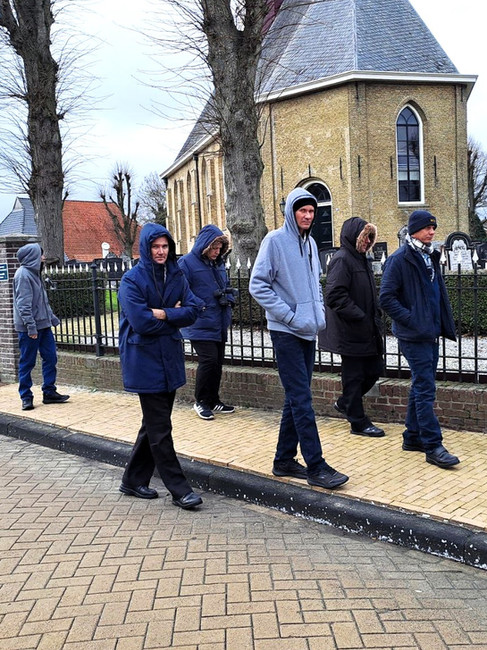
Visit in Witmarsum, Netherlands
Searching for Familiar Names
Before leaving Witmarsum, we walk through the cemetery. Jakob W. looks closely at the gravestones. But he does not find the typical Mennonite last names such as Friesen, Fehr, Klassen, or Dück. He had expected to see them here.
Shared Roots
In the evening in Minden, we continue talking about our ancestors. Are there shared family lines?
We use the search function of the GRanDMA database and actually find results. Benjamin looks specifically for connections between us and our guests and discovers several matches. Our families had common ancestors in southern Russia at least seven generations ago.

“The Ones Who Stayed”
Benjamin’s ancestors and mine stayed in Russia at that time. For our guests, we are still known as “the ones who stayed,” even though most of us now live in Germany. Because of this, they are very interested in how we live here today.
They want to know more about these “ones who stayed” in Germany, whom they also call “Plautdietsche Mensche.” Gerhard F. asks how many “Plautdietsche Mensche” live here and where exactly they live. Jakob W. wants to know why we do not live together in colonies. Another wonders why there are no Old Colony Mennonites here, since that is the group they belong to.
“Was there ‘trubbel’ in Russia when you switched from horse-drawn buggies to cars?” Jakob W.
Then comes the question I least expected. Jakob W. asks whether there was “trubbel” in Russia when we changed from horse-drawn buggies to cars. By “trubbel,” he means unrest or conflict — whether there were problems with church rules when people began using a more modern form of transportation.
“Trubbel” = unrest, troubleConversations About Faith
Along with all the conversations about background and history, we also talk about our personal faith. The life of Menno Simons and the Martyrs Mirror, which is well known among them, give us reason to reflect.
We speak about conversion, new birth, and the meaning of persecution, as experienced by the early Anabaptists. In these talks, we discover some differences, but also many things we share in common.

Modern Agriculture
The next morning I say goodbye. The group continues on to a large dairy farm near Büdingen. There they see that the milking is done completely by robots.
After that, they visit the production site of a prefab home company. They watch the processes with great interest.
In Belize, they run small businesses themselves. Many are craftsmen or traders, others are farmers. They grow vegetables and grain or raise animals. Much of their life is based on self-sufficiency. They do not receive electricity from a public power grid; each house produces its own power.


Visit to a dairy farm near Büdingen
Memories of Russia
In the evening, they are invited to the Peters family’s home and look at photos from Russia. They listen carefully as stories are told about the lives of “the ones who stayed” — about revolution, war, and communism. In their colonies, they have heard about these events again and again.

Farewell After an Intense Week
The next day it is time to say goodbye. In just one week, they have traveled about 1,900 miles across Europe. They take many impressions and experiences back home with them to Belize.

Looking Back: Understanding Instead of Prejudice
I look back on this encounter with gratitude. During their visit, they were also confronted with criticism that can be found on social media and in other reports. Much of it was already familiar to them.
They often felt misrepresented by former members who had left their communities. Calmly and objectively, they explained their perspective and cleared up some misunderstandings.
During this time, I gained many new insights into their way of life. I can see that my understanding of their lifestyle has grown.
Distant “relatives” have become friends.
Additional Information About Mennonites in Belize:


Kommentare